Laminated Rubber Bearing
Laminated Elastomeric Bearing Pad
Laminated Bearing Pads for Bridges, Precast & Heavy Structures
What Is a Laminated Bearing Pad?
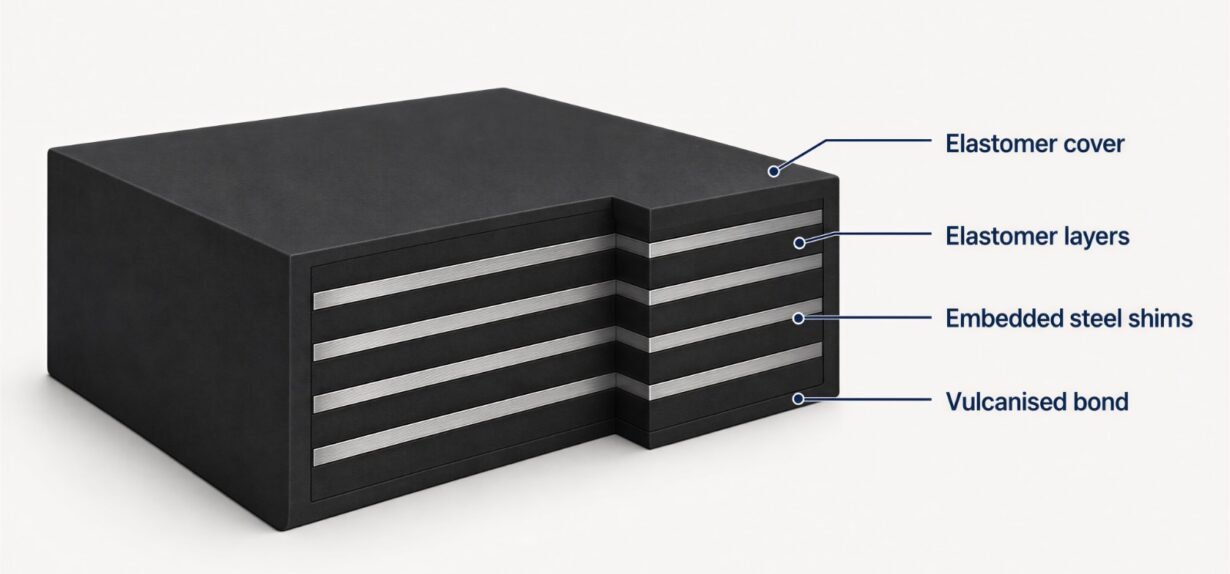
A laminated bearing pad, also called a laminated elastomeric bearing or steel-reinforced elastomeric bearing, is a bearing assembly made from alternating layers of elastomer and steel reinforcement.
It’s a set of alternating layers of neoprene or natural rubber along with steel plates that are moulded together under heat and pressure also called as vulcanization process that make it single unit. vulcanization process makes rubber and steel to bond together permanently. The final product is called laminated bearing pad. These pads are designed to take more load of bridge or heavy concrete structure compare to plain bearing pads.
How a Steel-Reinforced Elastomeric Bearing Works
Use the supplied section explaining:
- Vertical load transfer
- Horizontal movement
- Rotation
- External elastomer cover
- Internal elastomer layers
- Embedded steel shims
- Vulcanised bond

| Bearing element | Function in assembly | Why it matters |
|---|---|---|
| External elastomer cover | Protects reinforcement and forms bearing faces | Maintains continuous elastomeric envelope |
| Internal elastomer layers | Controlled deformation | Accommodates calculated movement |
| Embedded steel shims | Reinforce elastomer | Limits lateral bulging |
| Vulcanised bond | Joins elastomer and steel | Creates integrated bearing |

Applications
Typical Applications for Laminated Elastomeric Bearing Pads
- Bridge bearings
- Precast concrete beam supports
- Viaduct components
- Building transfer points
- Selected industrial/infrastructure supports
Benefits
Why Choose a Laminated Rubber Bearing?
Use the supplied explanation about:
- Structural support
- Movement accommodation
- Steel laminations
- Elastomer shear flexibility
- Compact bearing solution
What Information Is Needed for a Bearing Pad Quote?
| Requirement | Information |
|---|---|
| Vertical reactions | Service and ultimate bearing reactions |
| Movement | Longitudinal and transverse movement |
| Rotation | Maximum rotation |
| Geometry | Dimensions and available height |
| Interface | Beam/girder and support details |
| Environment | Location, temperature and chemical exposure |
| Specification | Drawings, bearing schedule and applicable standard |
Frequently Asked Questions
What is the difference between a laminated bearing pad and a neoprene bearing pad?
Use the supplied answer.
Can a laminated bearing pad accommodate movement and rotation?
Use the supplied answer.
Are laminated bearing pads used for bridges?
Use the supplied answer.
What information do you need to quote a laminated bearing pad?
Use the supplied answer.
Can you manufacture to a standard such as BS EN 1337-3 or ASTM D4014?
Do not publish a blanket compliance claim.
Need a laminated bearing pad for a bridge, precast or heavy-structure project? Contact the Berzelius team with your bearing schedule or drawing. We will review the required load, movement, rotation, dimensions and environmental conditions to help identify the appropriate project-specific solution.