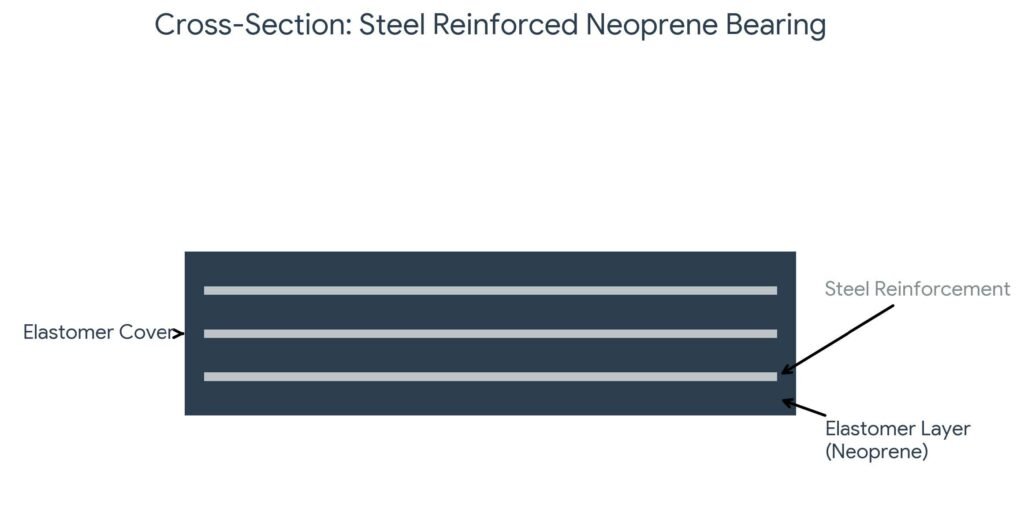
When we drive over a massive steel bridge, we marvel at the towering arches and the thick suspension cables. However, one of the most critical components ensuring the bridge’s survival over decades is often hidden in plain sight: the elastomeric bearing pad. Bridge bearings act as the vital connection between the dynamic superstructure (the bridge deck and girders) and the stationary substructure (the piers and abutments). Among the most versatile and economical choices available to modern engineers are steel-reinforced elastomeric bearings, frequently manufactured using high-grade neoprene. Why Neoprene? Elastomers, a category that includes both natural rubber and neoprene, are incredibly unique materials. They are highly flexible under shear stress (allowing the bridge to translate and rotate) but are incredibly stiff against volume changes. Neoprene, in particular, offers superior resistance to ozone and a wide array of harsh chemicals compared to natural rubber. This makes it an ideal choice for bridges exposed to harsh industrial environments or aggressive urban smog. The Magic of Steel Reinforcement While plain elastomeric pads (PEP) exist, they are limited to relatively short spans and low loads because they rely solely on friction to prevent the rubber from bulging out under immense weight. Enter the steel-reinforced elastomeric bearing. By vulcanizing uniform, alternating layers of elastomer and thin steel plates together, engineers fundamentally change the pad’s structural behavior. The steel layers restrain the lateral expansion (bulging) of the rubber. This dramatic increase in compressive stiffness allows the bearing to support massive loads—sometimes upwards of 1,000 kips —while retaining the shear flexibility needed to accommodate thermal expansion, contraction, and traffic-induced rotation.
When we drive over a massive steel bridge, we marvel at the towering arches and the
thick suspension cables. However, one of the most critical components ensuring the
bridge’s survival over decades is often hidden in plain sight: the elastomeric bearing pad.
Bridge bearings act as the vital connection between the dynamic superstructure (the
bridge deck and girders) and the stationary substructure (the piers and abutments).
Among the most versatile and economical choices available to modern engineers are
steel-reinforced elastomeric bearings, frequently manufactured using high-grade
neoprene.
Why Neoprene?
Elastomers, a category that includes both natural rubber and neoprene, are incredibly
unique materials. They are highly flexible under shear stress (allowing the bridge to
translate and rotate) but are incredibly stiff against volume changes. Neoprene, in
particular, offers superior resistance to ozone and a wide array of harsh chemicals
compared to natural rubber. This makes it an ideal choice for bridges exposed to harsh
industrial environments or aggressive urban smog.
The Magic of Steel Reinforcement
While plain elastomeric pads (PEP) exist, they are limited to relatively short spans and low
loads because they rely solely on friction to prevent the rubber from bulging out under
immense weight. Enter the steel-reinforced elastomeric bearing.
By vulcanizing uniform, alternating layers of elastomer and thin steel plates together,
engineers fundamentally change the pad’s structural behavior. The steel layers restrain
the lateral expansion (bulging) of the rubber. This dramatic increase in compressive
stiffness allows the bearing to support massive loads—sometimes upwards of 1,000 kips
—while retaining the shear flexibility needed to accommodate thermal expansion,
contraction, and traffic-induced rotation.
WhatsApp us