When it comes to fire safety in high-stakes environments—like enclosed transit systems, dense server aisles, and high-voltage battery packs—”good enough” is a dangerous standard. Engineers and architects are constantly pushing the boundaries to find materials that don’t just resist heat, but actively stop the spread of flames while keeping the air clear.
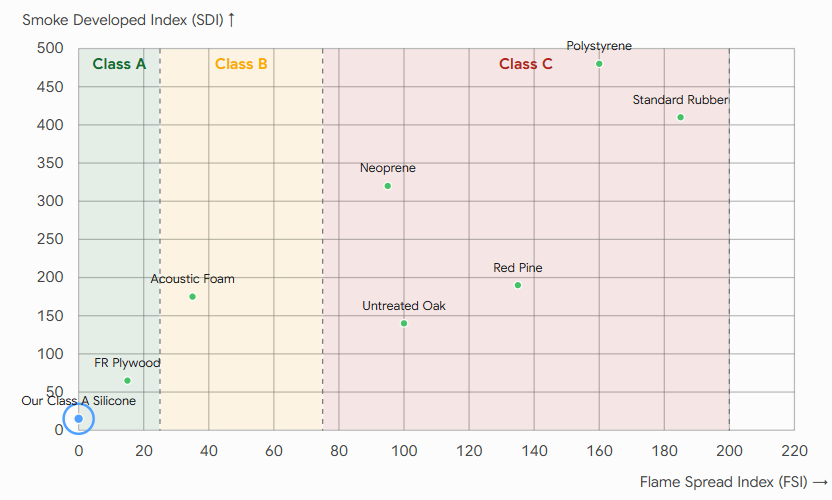
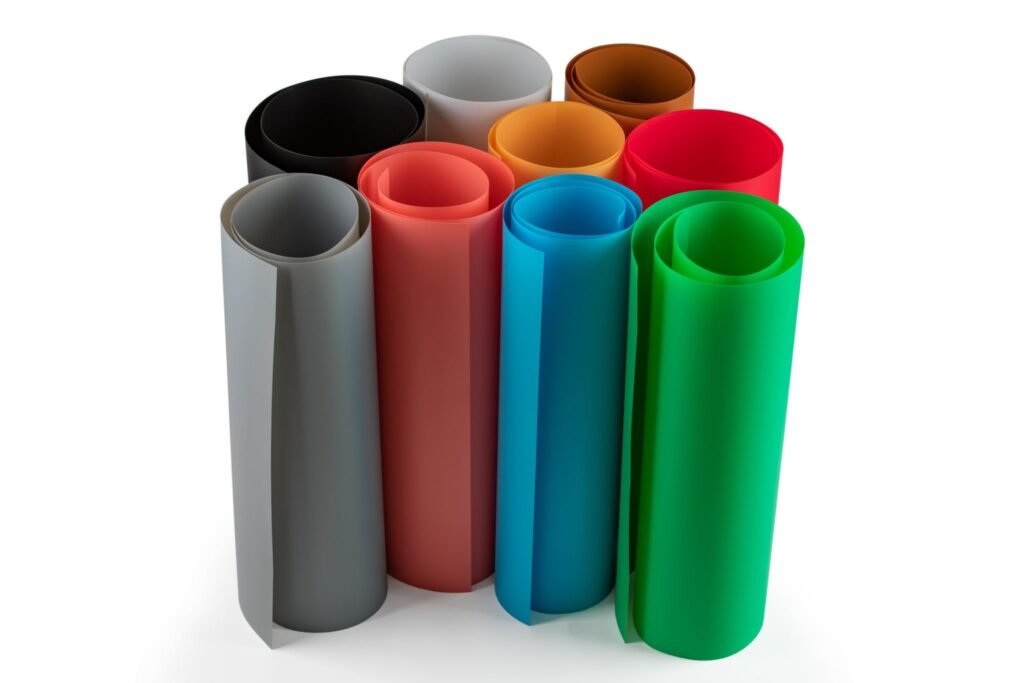
Today, we are thrilled to announce an industry milestone that redefines what is possible in polymer engineering: an ASTM E84 / UL 723 Class A Silicone Rubber Sheet with a Flame Spread Index (FSI) of absolute Zero and a Smoke Developed Index (SDI) of < 25.
But the breakthrough doesn’t stop at the chemical formulation. We are proud to be the one and only company to have successfully tested this material on a massive, continuous 4.3 Square Meter (SQM) specimen.
Here is why this achievement is a game-changer for the future of industrial fire safety.
The Gold Standard: Understanding ASTM E84 & UL 723
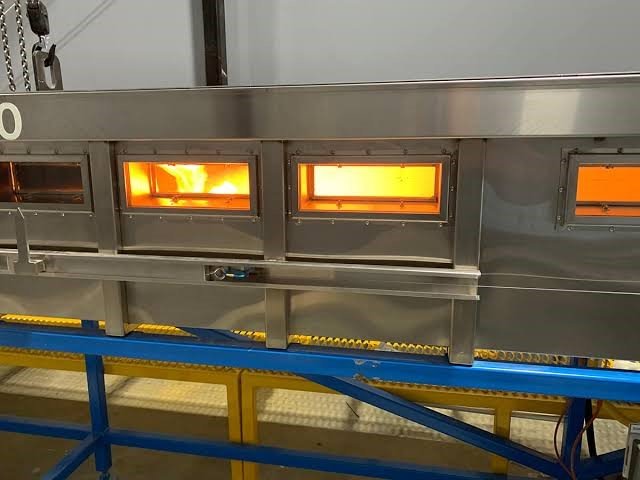
For those outside the compliance lab, ASTM E84 and its equivalent UL 723 (the Steiner Tunnel Test) are the premier North American standards for assessing the surface burning characteristics of materials. They measure two critical metrics:
- Flame Spread Index (FSI): How fast and how far flames travel across the surface.
- Smoke Developed Index (SDI): The concentration of smoke the material emits as it burns.
To achieve a true Class A (or 0/25) rating—the most elite category for interior and industrial applications—a material must have an FSI of 0–25 and an SDI of under 50. Our silicone rubber shattered this baseline, achieving an FSI of 0 and an SDI of < 25.
An FSI of Zero means that under direct, intense flame, the material acts as a definitive barrier and refuses to propagate the fire. An SDI of < 25 means that even under extreme thermal stress, it emits minimal smoke, ensuring visibility and reducing toxic inhalation risks.
The 4.3 SQM Difference: Why Size Matters
Formulating a fire-proof polymer in a petri dish is one thing; scaling it into a functional industrial product is another. We are the only manufacturer to have run the rigorous UL 723 test using a massive 4.3 SQM continuous specimen.
- Real-World Scale: In real-world applications, materials are applied across vast surfaces. Testing at 4.3 SQM proves that our 0/25 rating holds up on a macro scale.
- No Weak Links: Testing a large, continuous sheet proves the homogenous integrity of the silicone. There are no flammable seams or inconsistencies.
- Manufacturing Prowess: It demonstrates our unmatched capability to manufacture and cure ultra-high-grade, fire-retardant silicone in large, commercial-ready dimensions.
Redefining Safety Across Three Critical Industries
A flexible, durable material with a 0/25 fire rating opens up entirely new design possibilities for engineers facing strict regulatory compliance:
- Battery Manufacturing & EVs
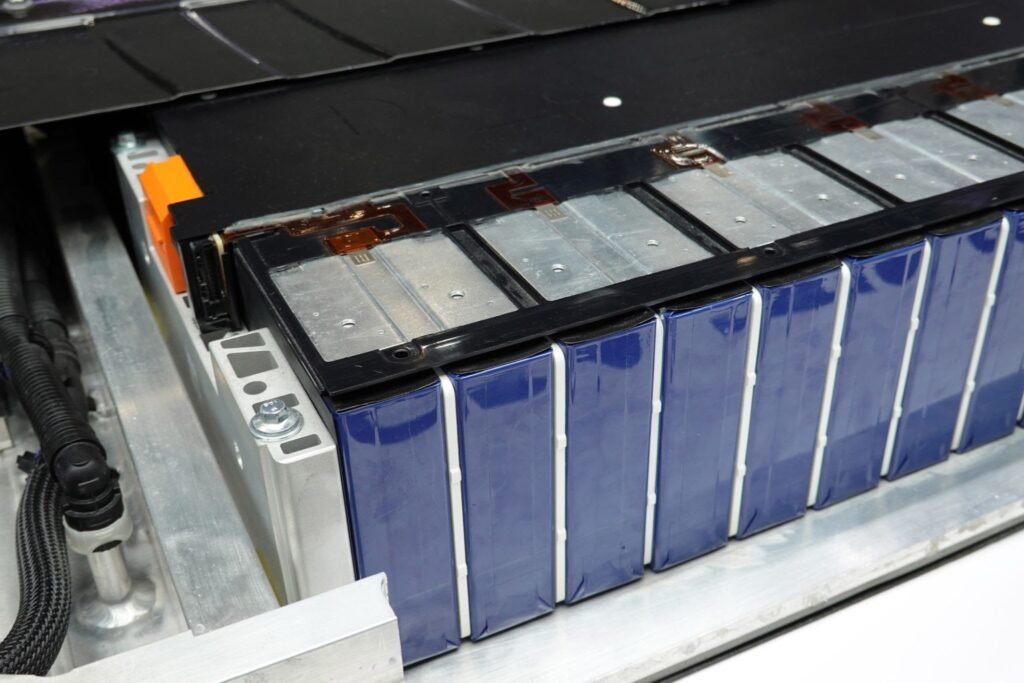
In the era of electrification, thermal runaway is the primary safety hurdle. When a single lithium-ion cell fails, the resulting chain reaction can be catastrophic.
- The Application: Thermal barrier linings, battery enclosure seals, and inter-cell dividers.
- The Advantage: With an FSI of 0, our silicone halts flame propagation dead in its tracks, isolating the thermal event and giving occupants precious time to evacuate. The low smoke profile (SDI < 25) prevents smoke from overwhelming the cabin interior.
- Mass Transit & Railway
Passenger trains are highly enclosed environments where fire and smoke are exponentially more dangerous than in open spaces.
- The Application: Gangway bellows, flooring underlays, HVAC seals, and interior panel isolation.
- The Advantage: In a rail fire, smoke inhalation and loss of visibility are often more lethal than the flames themselves. Our SDI < 25 rating ensures that escape routes remain visible, directly supporting strict mass transit safety mandates while maintaining the flexibility needed for vibrating rail environments.
- Datacenters & Critical Infrastructure
Modern datacenters pack immense power and heat into confined server aisles. A fire here doesn’t just threaten the building; it threatens millions of dollars in hardware and catastrophic data loss.
- The Application: Hot/cold aisle containment seals, cable penetration barriers, and raised-floor gasketing.
- The Advantage: An FSI of 0 prevents localized electrical fires from traveling up server racks or through cable trays. Equally important, the ultra-low smoke generation prevents corrosive soot and particulate matter from permanently destroying sensitive microelectronics in adjacent, unaffected racks.
Frequently Asked Questions (FAQ)
What is the difference between ASTM E84 and UL 723?
Practically, nothing. Both refer to the Steiner Tunnel Test method for surface burning characteristics. Achieving a Class A rating under either standard requires the exact same rigorous performance.
Why is an SDI of < 25 so important?
Many materials can resist flames but will smolder and release thick, toxic black smoke when exposed to high heat. An SDI under 25 is an exceptionally strict threshold that ensures minimal smoke generation, which is critical for life-safety evacuations and protecting sensitive equipment from soot damage.
Why does a 4.3 SQM test size matter more than a standard test?
Many manufacturers test small, highly optimized samples to pass compliance. Testing a massive 4.3 SQM (over 46 square feet) continuous sheet proves that our manufacturing process delivers consistent, flawless fire resistance across large, commercial-scale production runs without weak points.
Does this silicone rubber lose its flexibility to achieve these ratings?
No. Our compounding breakthrough allows the silicone to maintain its inherent elasticity, tensile strength, and extreme temperature resilience (-60°C to +250°C) while achieving elite Class A fire performance.
We didn’t just meet the highest safety standard in the industry; we maxed it out on a scale no one else has achieved. If your next project demands absolute, uncompromising fire resistance without sacrificing the performance of premium silicone rubber, the standard has officially been raised.
Ready to see the specs for yourself? Contact our engineering team today to request the official test reports and material samples.