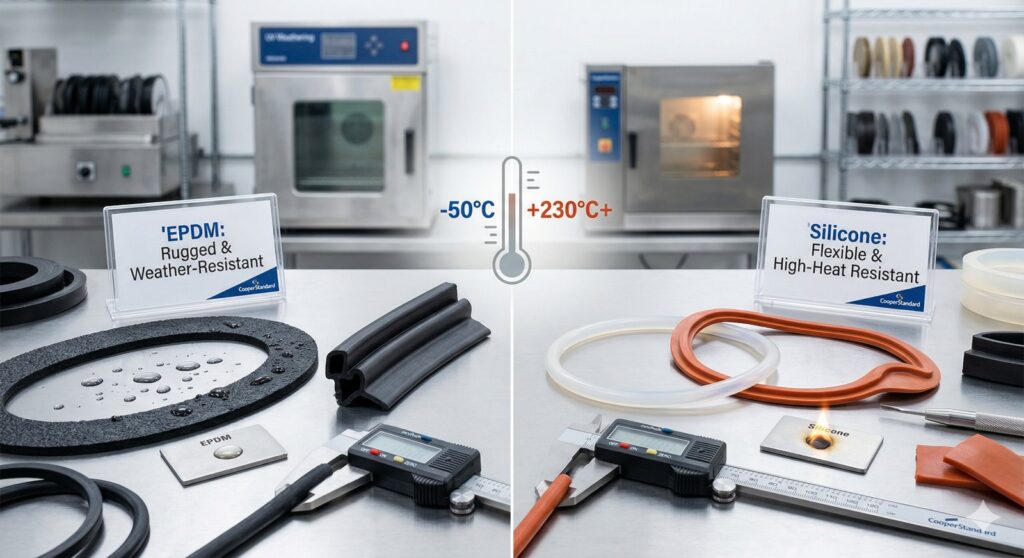
Selecting the ideal material for seals and gaskets is a critical engineering decision. While both EPDM (Ethylene Propylene Diene Monomer) and Silicone are industry staples for molded and extruded applications, their chemical compositions lead to distinct performance advantages.
Understanding these nuances—especially regarding fire safety and specialized industry requirements—is key to ensuring long-term part integrity.
Material Comparison: At a Glance
Feature | EPDM | Silicone |
Temperature Range | -50°C to +150°C | -60°C to +230°C+ |
UV & Ozone Resistance | Excellent | Excellent |
Chemical Resistance | High (Acids/Alkalis) | Moderate |
Tensile Strength | High | Low to Moderate |
Abrasion Resistance | Good | Poor |
Cost | Generally Lower | Generally Higher |
EPDM: The Rugged, Cost-Effective Workhorse
EPDM is favoured for its exceptional durability in outdoor environments. Its molecular structure allows it to withstand weathering, water, and aging without significant degradation.
Silicone: The High-Heat Specialist
Silicone excels where temperature extremes and electrical insulation are the primary concerns. It maintains its physical properties across a massive thermal window.
The Fire Rating Factor: Safety First
When it comes to fire safety, the choice often shifts toward specialized compounds.
Niche Applications & Industry Excellence
In military applications, materials must survive “worst-case” scenarios. Silicone is often utilized for its electromagnetic interference (EMI) shielding capabilities and stability in extreme climates. EPDM is used for ruggedized external seals on ground vehicles due to its abrasion resistance.
The marine environment is a relentless assault of salt water and UV radiation. Both materials offer the ozone resistance needed to prevent “dry rot,” but EPDM is frequently chosen for hatch seals and portlight gaskets because it stands up better to the mechanical wear of opening and closing.
While neither material is suited for direct contact with hydrocarbons (oil/gasoline), they serve vital peripheral roles.
Making the Final Decision
To determine if EPDM or Silicone is right for your project, you must weigh the end-use function against physical, mechanical, and chemical resistance requirements.
At Berzelius , our engineers specialize in navigating these material complexities. We work directly with your team to review application data and ensure the elastomer you choose isn’t just “good enough,” but optimized for the life of your product.
EPDM offers excellent weather and chemical resistance, while silicone provides superior high-temperature performance and flexibility.
Silicone is better for high temperatures, handling up to +230°C or more, while EPDM typically withstands up to +150°C.
Yes, EPDM generally has higher tensile strength and better abrasion resistance, making it more durable in mechanical applications.
WhatsApp us