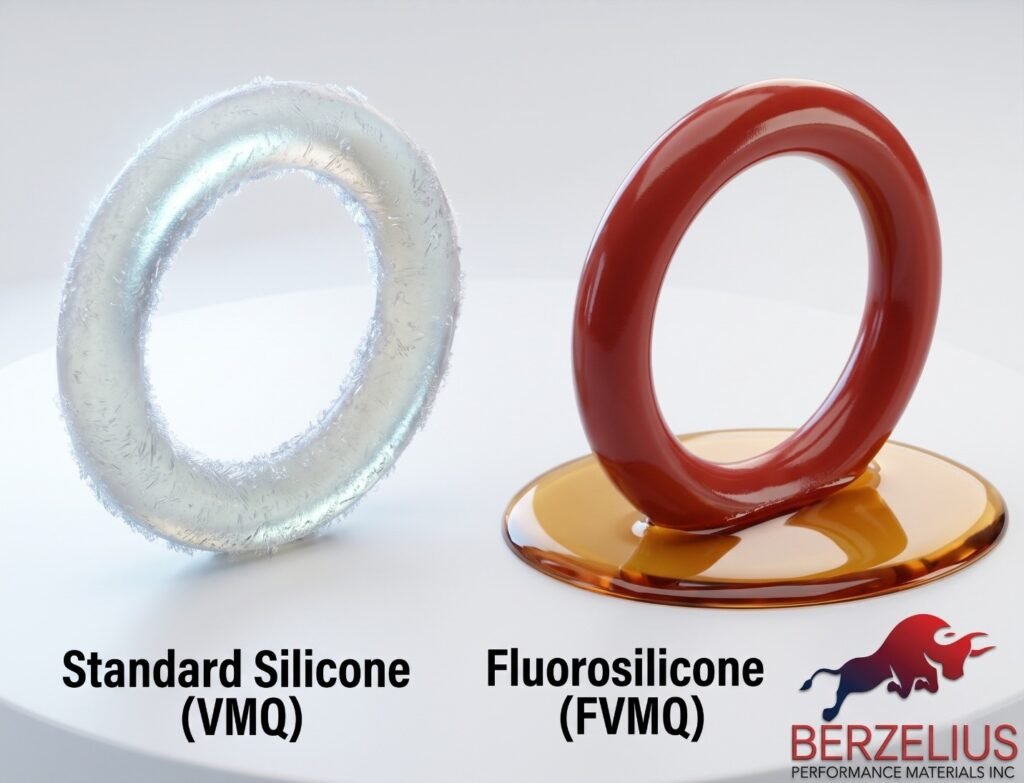
Selecting the right elastomer for industrial gaskets and seals requires balancing temperature resistance with environmental exposure.
Feature | Standard Silicone (VMQ) | Fluorosilicone (FVMQ) |
Operating Temperature | -50°C to +250°C (Up to 350°C in special mixes) | -60°C to +200°C |
Chemical Resistance | Poor resistance to fuels and hydrocarbon solvents | Excellent resistance to jet fuels, engine oils, and solvents |
Environmental Resistance | Exceptional (Ozone, UV, Weathering) | Exceptional (Ozone, UV, Weathering) |
Primary Applications | Architectural facades, HVAC seals, electrical insulation | Aerospace fuel systems, automotive emission controls, chemical plants |
Cost & Strength | Highly cost-effective, good tensile strength | More expensive, slightly lower tear/tensile strength |
Frequently Asked Questions
While both provide excellent flexibility across wide temperatures, fluorosilicone incorporates fluorocarbons into its polymer chain, providing superior chemical resistance to non-polar solvents and fuels.
Neither is recommended for highly dynamic sealing. Both materials exhibit high friction characteristics and low abrasion resistance, making them strictly ideal for static seal applications.
WhatsApp us