Technical Property | Standard Sulfur-Cured EPDM | Peroxide-Cured Facade EPDM |
Max Continuous Temp | +100°C | +130°C to +150°C |
Compression Set (22h @ 100°C) | 40% – 50% | < 20% – 25% |
UV & Ozone Resistance | Moderate | Zero cracking (ASTM D1149) |
Silicone Compatibility | Risk of oil migration | 100% Non-bleeding / Non-staining |
Compliance with Regional Codes (ESTIDAMA, Mostadam & Civil Defense)
Frequently Asked Questions (FAQ)
Q: Why are peroxide-cured EPDM gaskets preferred over silicone gaskets for curtain walls?
A: While structural silicone is ideal for bonding glass to aluminum, peroxide-cured EPDM offers superior tear strength, dynamic recovery, and cost efficiency for continuous mechanical weather-seals around unitized panels.
Q: Do EPDM gaskets react with structural silicone sealants?
A: Standard EPDM can bleed plasticizers into adjacent structural silicone, leading to bond failure. Specifying silicone-compatible or peroxide-cured EPDM profiles prevents plasticizer migration.
Q: What is the typical service life of EPDM facade gaskets in desert environments?
A: Properly formulated EPDM gaskets meeting ASTM C864 / DIN 7863 retain elasticity and sealing capacity for 25 to 30+ years under extreme UV exposure.
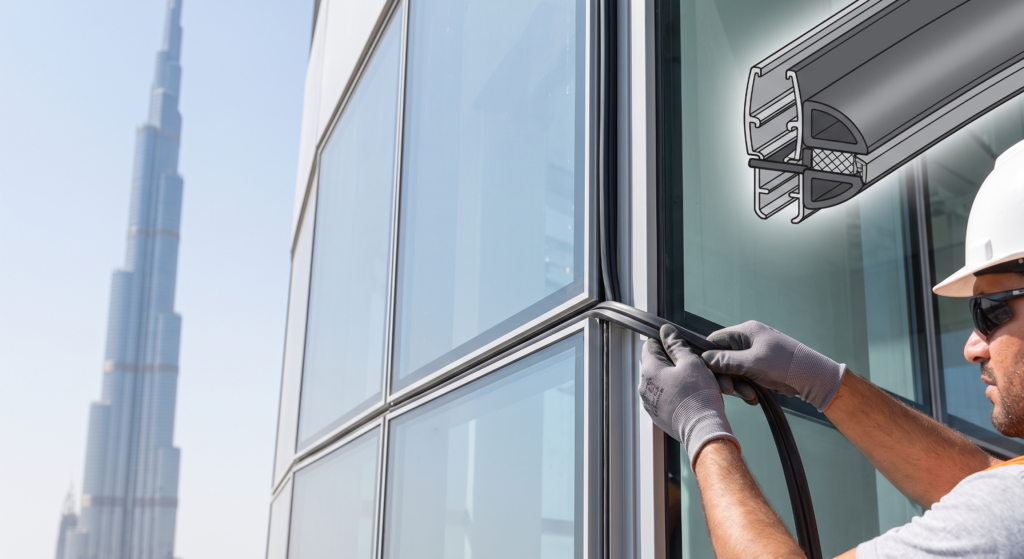
High-rise commercial and residential architecture across the GCC—from Riyadh’s King Abdullah Financial District to Dubai’s skyline—relies on extensive glass curtain wall facades. While floor-to-ceiling glass creates striking aesthetics, it exposes the building envelope to extreme heat cycles. When surface glass temperatures exceed 60°C during Middle Eastern summers, standard elastomer seals degrade, crack, and lose elasticity.
To protect structural integrity and maintain energy efficiency, facade consultants specify Peroxide-Cured EPDM (Ethylene Propylene Diene Monomer) Gaskets.
The Engineering Challenge: Severe Thermal Cycles & UV Radiation
Glass and aluminum profiles expand and contract continuously throughout the day. Traditional sulphur-cured rubber profiles suffer from high compression set—meaning they lose their spring-back force under constant heat and compression. Over time, this leads to:
Why Peroxide-Cured EPDM Outperforms Standard Extrusions
Unlike standard extrusions, peroxide-cured EPDM forms carbon-to-carbon molecular cross-links that yield exceptional heat and chemical resistance:
WhatsApp us