Frequently Asked Questions (FAQ)
Q: What is the difference between static deflection and vibration transmissibility?
A: Static deflection is the distance a rubber mount compresses under the weight of static equipment. Transmissibility measures the percentage of dynamic vibration force passed through the mount into the structure. Higher static deflection generally yields better vibration isolation efficiency.
Q: How do engineers prevent rooftop mounts from deteriorating in desert heat?
A: By specifying high-grade Neoprene (Polychloroprene) or EPDM elastomers formulated with antioxidant and anti-ozonant additives, which maintain dynamic elasticity under high heat and direct UV exposure.
Q: When should a composite pad (Rubber + Cork) be specified over a solid rubber pad?
A: Composite Neoprene/Cork pads excel under high compressive loads where space is tight, offering high dynamic dampening and minimal lateral bulging under light-to-medium HVAC machinery.
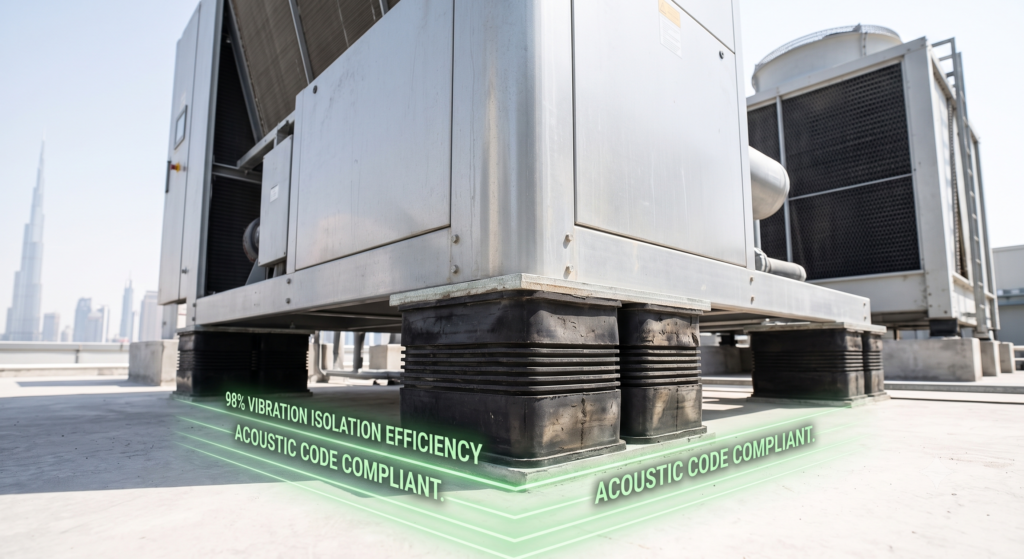
Due to the regional climate, large commercial and residential buildings across the Middle East rely on massive, continuously running mechanical plant systems. Heavy rooftop chillers, cooling towers, air handling units (AHUs), and emergency diesel generators generate intense structure-borne vibrations.
Without proper isolation, these vibrations travel through concrete columns and floor slabs, manifesting as low-frequency hums inside tenant spaces. Engineered Anti-Vibration Elastomeric Mounts and Pads isolate mechanical equipment at the source, ensuring compliance with strict regional acoustic codes.
Mechanics of Vibration Isolation: Elastomers vs. Metal Springs
While steel coil springs handle low-frequency mechanical movements, high-density neoprene and natural rubber isolators offer superior high-frequency acoustic damping. Rubber compounds dissipate mechanical energy through internal viscous hysteresis—converting dynamic movement into harmless micro-heat. This eliminates metal-to-metal noise transmission.
Engineering Selection Criteria for GCC Rooftops
Meeting Regional Green Building & Acoustic Codes
WhatsApp us