Frequently Asked Questions (FAQ)
Q: Can hydrophilic swellable waterstops be exposed to rain during construction?
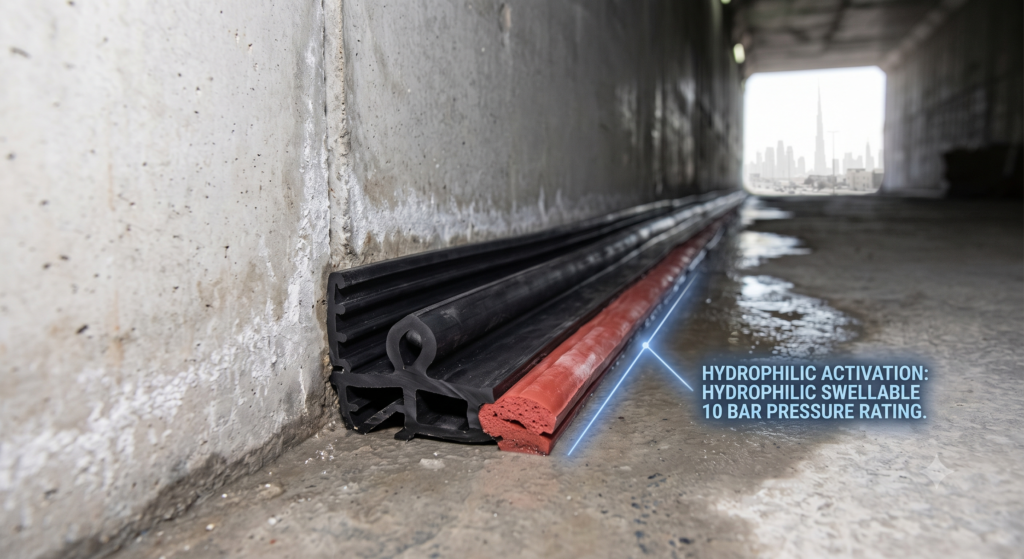
A: If a standard hydrophilic waterstop is exposed to premature rain before concrete is poured, it can swell early and disrupt the joint. Specifying delayed-action hydrophilic rubber waterstops prevents premature expansion during rain or site washing.
Q: Why are EPDM waterstops preferred over standard PVC waterstops for large concrete structures?
A: EPDM rubber offers much higher elasticity, superior thermal stability, and better recovery after cyclic joint movement compared to rigid or plasticized PVC, which can become brittle over time.
Q: What hydrostatic pressure can rubber waterstops withstand?
A: High-performance vulcanized rubber waterstop systems, when properly embedded, can withstand hydrostatic water heads exceeding 5 bar to 10 bar (50–100 meters of water pressure).
Constructing deep basements, underground rail stations, and water desalination facilities in coastal Middle Eastern cities (like Dubai, Doha, Abu Dhabi, and Jeddah) poses a significant challenge: aggressive saline groundwater. Coastal soils contain high concentrations of chlorides and sulfates, which degrade unsealed concrete expansion and construction joints.
To prevent structural water ingress and chemical deterioration, engineers rely on a dual-line defense: Vulcanized EPDM/Neoprene Waterstops combined with Hydrophilic Swellable Rubber Strips.
Active vs. Passive Rubber Waterstops
Overcoming Saline Groundwater Challenges
In coastal Middle Eastern groundwater, standard bentonite-based waterstops can lose their swelling capacity due to high salt concentrations. Chemical-Grade Hydrophilic Rubber Strips are specifically formulated with salt-tolerant polymers that retain expansion efficiency even when exposed to brackish or marine saline water.
Key Application Areas Across Middle East Construction
WhatsApp us