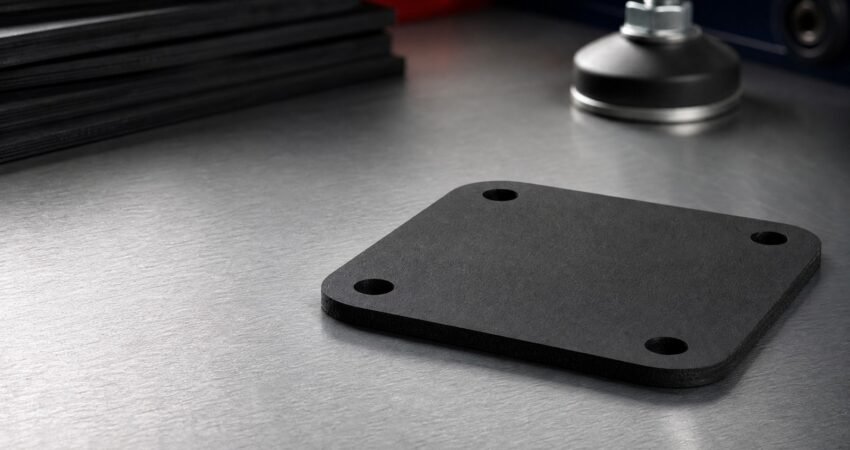
Neoprene Pads: A Practical Guide to Material Versatility and Application Selection
A neoprene pad can look deceptively simple. Yet in construction, precast, machinery and industrial assemblies, the pad often sits at the interface where load, motion, vibration, impact and exposure meet. A credible material decision therefore begins with the task the pad must perform—not with a catalogue dimension.
Berzelius Performance Materials offers neoprene in several product forms, including pads, sheets, strips, anti-vibration isolation pads, plain elastomeric bearing pads and laminated bearing pads. Its stated markets include construction, precast, automotive and bearing-pad applications.1 That breadth makes neoprene useful as a starting point for many projects, but it does not make every neoprene pad interchangeable.
Where a neoprene pad can add value
A pad may be selected to separate two surfaces, reduce local contact stress, cushion an interface, assist with vibration isolation or create a resilient layer within a support arrangement. Examples include support points beneath precast components, machinery interfaces, general protective pads, joint-isolation strips and engineered bearing-pad assemblies. The format matters: a sheet may be cut for a fabrication requirement, a strip may suit a continuous contact line, and a moulded or laminated pad may be necessary where the load path and movement demand a more specific configuration.1
The most effective description is therefore functional. Rather than asking for “a neoprene pad,” define the service need: support, separation, vibration isolation, impact protection, sealing, or controlled movement. This immediately narrows the design conversation.
Five questions before you specify
Question | Why it matters |
What is the applied load and contact area? | This affects compression, local stress and the required plan dimensions. |
Is there movement, rotation or repeated vibration? | A static packing pad and a bearing or isolation pad may require different geometry and material behaviour. |
What will contact the pad? | Concrete, painted steel, aluminium, equipment feet and rough surfaces create different interface considerations. |
What is the environment? | Weather, UV exposure, water, temperature, oils and cleaning media must be considered against the selected compound. |
How will it be installed? | Bonding, clamping, free placement, confinement and surface preparation can influence performance. |
The condition of the mating surfaces also matters. A pad cannot correct a poorly prepared, uneven or misaligned interface. In more demanding structural applications, the pad should be reviewed as one element of a complete assembly, alongside the surrounding concrete or steel, plates, fixings, movement allowance and inspection access.
Plain, isolation and bearing-pad formats are not the same thing
A general-purpose cut pad is often appropriate where the requirement is straightforward separation or protection. An anti-vibration pad may need to be chosen around equipment mass, excitation, support geometry and installation arrangement. A bridge or structural bearing is more specialised again: it is typically evaluated for the combination of compression, shear movement, rotation, stability and, where used, reinforcement.3
This distinction is important because a material that appears suitable in one setting may be inappropriate in another. It also prevents a common error: treating all black elastomer pads as equivalent simply because they have similar dimensions.
Build the enquiry around the service condition
A useful first enquiry to Berzelius should include a sketch or drawing, required length × width × thickness, estimated load, expected movement, installation concept, temperature range, exposure media and required standards or test documentation. Where the pad is part of a structural assembly, share the governing drawings and design assumptions with the responsible engineer.
Berzelius can then discuss an appropriate neoprene product route, whether that is a sheet, strip, isolation pad, plain bearing pad or laminated bearing-pad solution. The objective is not to supply the closest visible pad; it is to match the material and form to the application.
For an application discussion, visit www.bpmaterials.uk or contact sales@berzelius.uk.
WhatsApp us