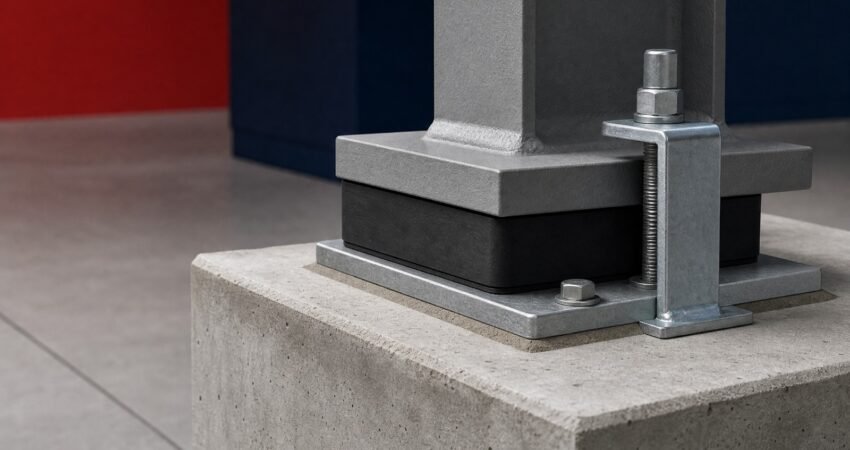
Neoprene Pads with Cemented Bases and Clamps: Designing the Whole Support Interface
A neoprene pad used beneath a steel or concrete component is often specified for a clear reason: to provide a resilient interface between two materials. Once a bedded or cemented base, plate and clamp are introduced, however, the detail becomes a support system. The pad, bedding interface, restraint hardware and surrounding structure must work together without defeating the intended movement or creating unplanned local stresses.
This does not mean that every pad requires a complex restraint detail. It means that the installation concept must follow the actual project need. In bearing applications, restraint can generate force when movement is prevented; the relevant load effects and service conditions must therefore be considered by the project design team.3
Start with the function of the assembly
The first question is whether the support is intended to be fixed, guided or free to accommodate some movement. A clamp may simply hold a component in a prescribed location during installation, may act as a positional restraint, or may be part of a more deliberate longitudinal or transverse restraint strategy. Those roles are not interchangeable.
A bedded or cemented base similarly needs clarification. It may refer to a levelling layer, a grout or mortar interface, a concrete plinth or a bonded interface. The material, thickness, preparation and curing requirements are project-specific. The pad should not be expected to compensate for poor level control, inadequate bearing area or an unsuitable surface condition.
Interface element | Engineering question to resolve |
Neoprene pad | What load, movement, vibration and environmental exposure must it accommodate? |
Bedding or cemented base | Is its purpose levelling, load distribution, fixing, filling or final positioning? |
Top or bottom plate | Does it distribute load, protect the elastomer, provide a fixing interface or manage tolerance? |
Clamp or restrainer | What movement is allowed, and which direction is intentionally restrained? |
Fasteners and metalwork | Are material grade, corrosion protection, edge distance and access for tightening appropriate? |
Surrounding structure | Does the detail remain stable and inspectable through construction and service? |
Avoiding the movement-versus-restraint conflict
A resilient pad can provide controlled deformation, but a clamp or fixed plate can alter the way a support assembly behaves. If the structural system is expected to expand, contract, rotate or settle, the restraint detail must be coordinated with that expectation. A clamp placed to prevent “walking” may be useful in one context and problematic in another if it blocks intended translation.
The FHWA’s elastomeric-bearing guidance highlights the need to consider forces created where movement is restrained and advises that bearings should be protected from the environment and accessible for inspection.3 These are useful principles even before the project design is finalised: ask what movement exists, what must be restrained, how the connection is protected, and how the interface will be inspected later.
Installation is part of the engineered outcome
A practical installation review should cover surface cleanliness and level, prescribed bedding or base preparation, pad orientation, plate alignment, clamp placement, fastener torque where specified, cure or set time for any bedding material, and temporary-versus-permanent restraint. The project drawings and the responsible engineer’s instructions must govern the work.
Visual checks are also valuable. Before final loading, confirm that the pad sits flat, the contact area is as intended, clamps do not pinch or damage the elastomer, and the assembly is not unintentionally locked against planned movement. For higher-risk or structural applications, keep inspection records with photographs, levels and installation measurements.
Begin with the details that matter
For a useful discussion with Berzelius, share the support drawing, materials either side of the pad, pad size and thickness, anticipated load, expected movement, proposed bedding/base, clamp geometry, exposure environment and any applicable specification. This allows the project team to consider whether a neoprene pad format is suitable and what information is needed for a safe, buildable interface.
To discuss a neoprene pad or bearing-pad requirement, visit www.bpmaterials.uk or email sales@berzelius.uk.
WhatsApp us