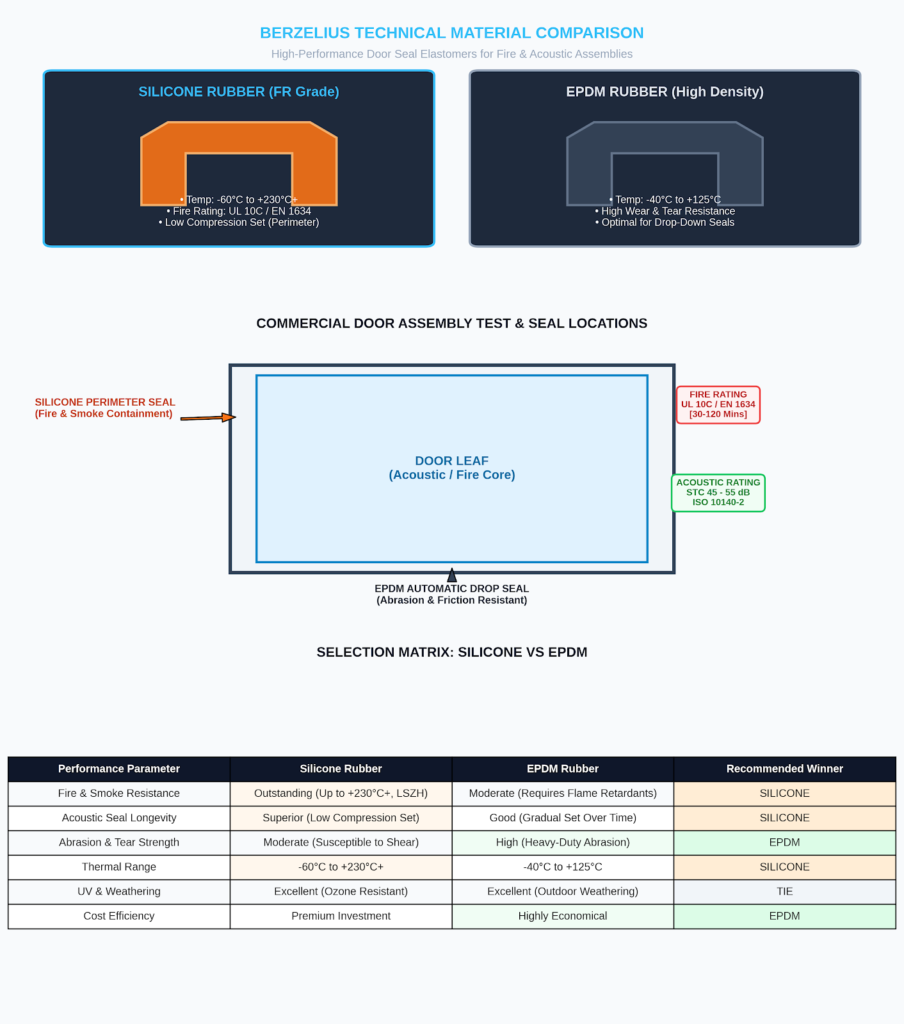
Selecting seal gaskets for commercial and industrial door assemblies requires a balance of mechanical durability, acoustic attenuation (STC/Rw ratings), and life-safety compliance (UL, EN, BS standards).
Two elastomers dominate the global door sealing industry: Ethylene Propylene Diene Monomer (EPDM) and Silicone Rubber. This guide examines their performance, global testing standards, and application fit.
Global Engineering Comparison Matrix
Performance Metric | EPDM Rubber Seal | Silicone Rubber Seal | Optimal Winner |
Operating Temperature | -40°C to +125°C (-40°F to 257°F) | -60°C to +230°C+ (-76°F to 446°F+) | Silicone |
Fire & Flame Resistance | Requires FR Additives; higher smoke density | Naturally Flame-Retardant (LSZH options) | Silicone |
Acoustic Sealing (Air-tightness) | Good; high density | Excellent; low compression set | Silicone (Perimeter) / EPDM (Drop-seals) |
Tear & Abrasion Strength | High tensile and tear resistance | Moderate; susceptible to cutting under high shear | EPDM |
UV & Weathering Resistance | Outstanding outdoor performance | Outstanding; non-reactive to ozone | Tie |
Material Cost | Economical / Cost-effective | Premium investment | EPDM |
Fire-rated doors restrict smoke, flame, and heat transfer during building emergencies.
Acoustic ratings (Sound Transmission Class / STC or Weighted Sound Reduction Index / Rw) depend on creating an airtight seal around the door frame and threshold.
Frequently Asked Questions (FAQ)
Q1: Is Silicone always better than EPDM for fire-rated doors?
A: Yes. Silicone handles significantly higher temperatures without melting or releasing dense toxic smoke. It is the material of choice for fire doors rated 30, 60, 90, and 120 minutes.
Q2: Which material provides better acoustic isolation (STC rating)?
A: Both materials can achieve high STC ratings (50+ dB) if properly extruded and fitted. However, silicone retains its acoustic airtightness longer because it resists permanent deformation (low compression set) better than EPDM.
Q3: Can EPDM seals be used outdoors?
A: Absolutely. EPDM offers outstanding resistance to UV radiation, ozone, rain, and extreme weather, making it an ideal choice for exterior commercial door weather-stripping.
Q4: Why is EPDM used on automatic bottom drop seals instead of silicone?
A: EPDM has higher tear and abrasion resistance. Because threshold drop-seals continuously drag across floor finishes, EPDM holds up better against mechanical abrasion over time.
WhatsApp us